Loopback Transformer: Towards a Unified View of Residual Looped Transformers
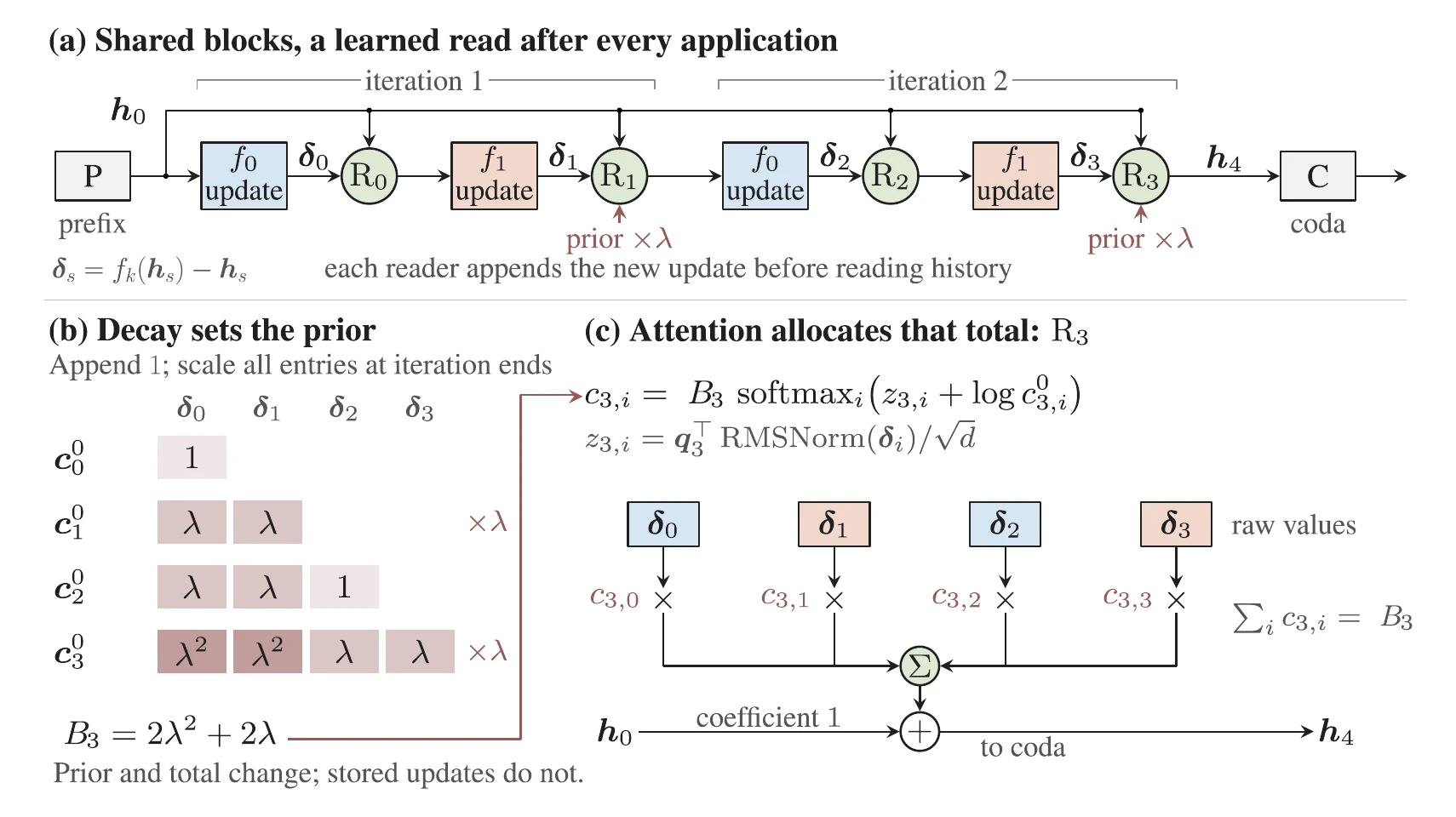
Store each block’s update, not its output. In a looped Transformer the same blocks run repeatedly, so the residual connection decides how earlier computation survives into later visits. Loopback separates that choice into three quantities that ordinary addition entangles: input strength, total update weight, and how that weight is split across updates. Each block writes its update into an explicit history, while the shared stack’s input stays on a separate path with coefficient one. Geometric decay sets a recency prior and bounds the total update weight; a learned query scores the normalized updates, and a softmax redistributes the same total by content. Only residual aggregation changes.
On ClimbMix, with training tokens and executed depth matched, Loopback reaches lower validation loss than standard Transformers from 191M to 3B while storing 40–75% of their Transformer parameters (excluding token embeddings and the output head). At 191M, 374M and 778M the losses are lower by 0.005, 0.039 and 0.024 nats, and it has the highest thirteen-task mean among the standard Transformer and seven looped residual designs. At 1.4B and 3B its thirteen-task mean is also higher, by 0.17 and 0.89 points. Residual aggregation adds only 0.04–0.08% forward FLOPs in the three measured configurations (191M–778M), but training throughput is lower than the standard model’s: 6% lower at 3B and roughly 16–25% lower at 191M–778M, with higher peak memory per GPU at those three scales. Explicit history adds memory traffic and activations, so parameter savings need not reduce latency or peak memory. The evidence is limited to ClimbMix pretraining at the tested scales, with single-run large-scale comparisons.